
One conch sound… and an entire nation paused.
Every 90’s kid will know exactly what I mean when I say — Sunday mornings were sacred.
Not for brunches, not for outings, but for B.R. Chopra’s Mahabharat.
It wasn’t just a television show; it was an event — a grand weekly ritual every household followed with devotion.
The moment that powerful title song began — the deep Sanskrit chants and the echoing conch — something changed in the air.
It felt like a divine call to pay attention.
A voice that said —
“Main Samay hoon…” — those words still give us goosebumps.
Fathers would adjust the antenna just right, elders would call everyone to gather, and children would rush to the living room — eyes wide, hearts steady.
Even during weddings or family functions, someone would always say,
“TV chalu kar do zara, Mahabharat shuru hone wala hai.”
For that one hour, the world outside didn’t exist.
Life paused — as if the whole nation was breathing in rhythm with the story.
And what made it even more special?
It wasn’t bound by religion or region.
People from all faiths, all backgrounds, all corners of India watched it with the same reverence.
Hindus, Muslims, Sikhs, Christians — it didn’t matter.
Because Mahabharat wasn’t about one religion; it was about humanity, duty, and timeless truths.
Every home — whether it had an idol, a cross, or a prayer mat — had its eyes fixed on the same screen.
There were no replays, no streaming apps, no “skip intro” buttons — just that one sacred telecast every Sunday morning.
Miss it, and you’d spend the week catching up through your neighbors’ excited narrations.
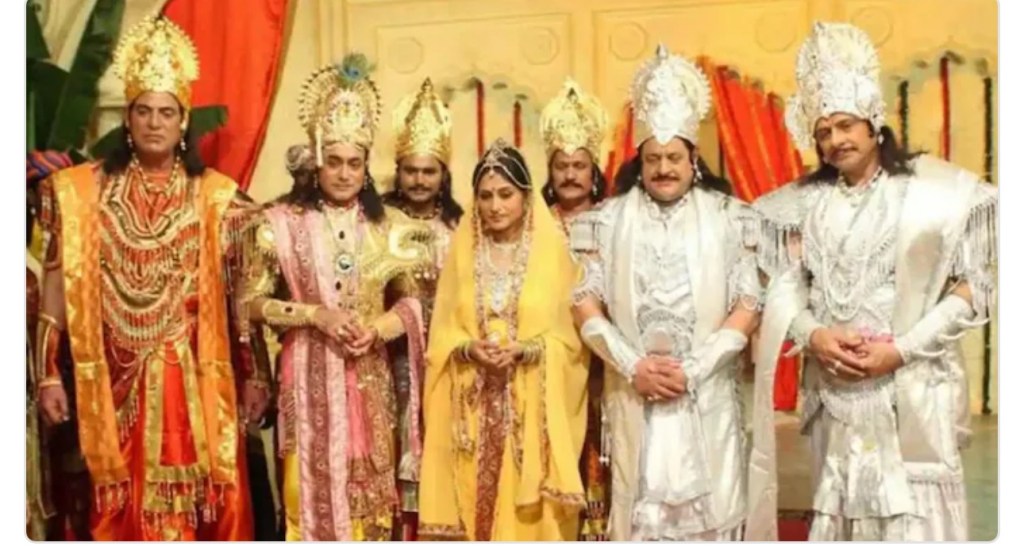
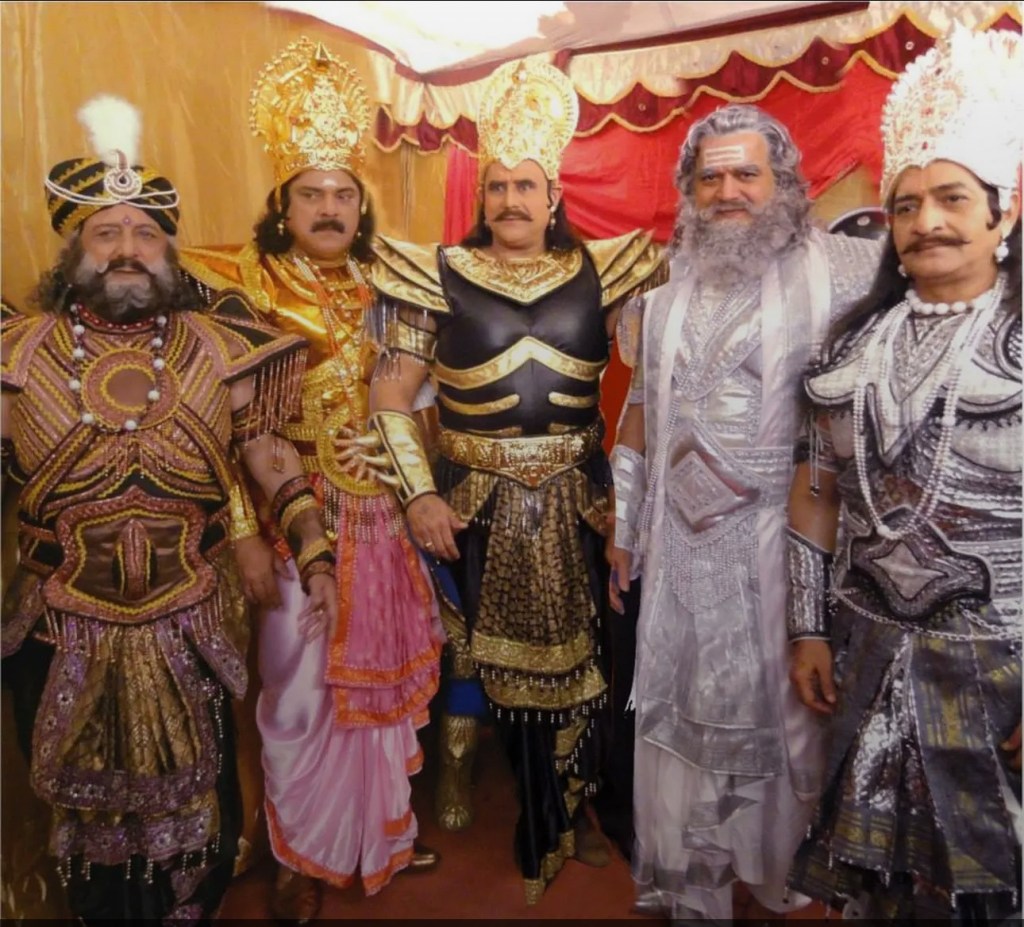
Each character felt so real that we still remember them not by their real names, but by the ones they brought to life.
Nitish Bharadwaj will forever be Lord Krishna — calm, wise, and divine.
Puneet Issar — the fierce Duryodhan.
Roopa Ganguly — the graceful yet unyielding Draupadi.
Gajendra Chauhan — the ever-righteous Yudhishthir.
Firoz Khan — the intense Arjun, torn between duty and heart (who later changed his name to Arjun).
Pankaj Dheer — the noble Karna, whose dignity still commands respect.
And Mukesh Khanna — our Bhishma Pitamah, whose every word carried the weight of truth, wisdom, and sacrifice.
We didn’t see them as actors — they were epic souls reborn for our generation.
And when Krishna spoke the words,
“Karmanye vadhikaraste ma phaleshu kadachana…”
we might not have understood it fully then — but the verse lingered in our minds.
It grew with us, whispering its meaning in moments of struggle and reflection.
Mahabharat wasn’t just a story — it was an education in life.
After every episode, living rooms turned into discussion zones — fathers quoting Bhishma Pitamah, mothers admiring Draupadi’s strength, and children re-enacting the war of Kurukshetra with sticks, towels, and unshakable intensity.
Those were simpler times.
One television per home. One channel. One nation watching together.
No scrolling, no spoilers — just pure connection and collective awe.
Today, we have endless OTT platforms, glossy visuals, and remakes — yet none carry the same emotion, depth, or unity that Mahabharat created every Sunday morning.
B.R. Chopra didn’t just give us a television show.
He gave us a memory that refuses to fade.
He gave us a shared heartbeat — an experience that united generations, communities, and faiths.
And today, as we remember those golden mornings, we bow our heads in respect to the departed soul — Pankaj Dheer, our very own Karna.
He will forever remain Karna for us — noble, dignified, and immortal in our memories🙏😢


 Blessmesai